Home / How to fish
How to fish for Ohio steelhead
Gear, bait, rigs and reading water, quoted from Ohio’s and neighboring states’ fishery agencies, the park districts and Ohio anglers. Each quote names who said it; New York and Pennsylvania quotes are labeled as theirs.
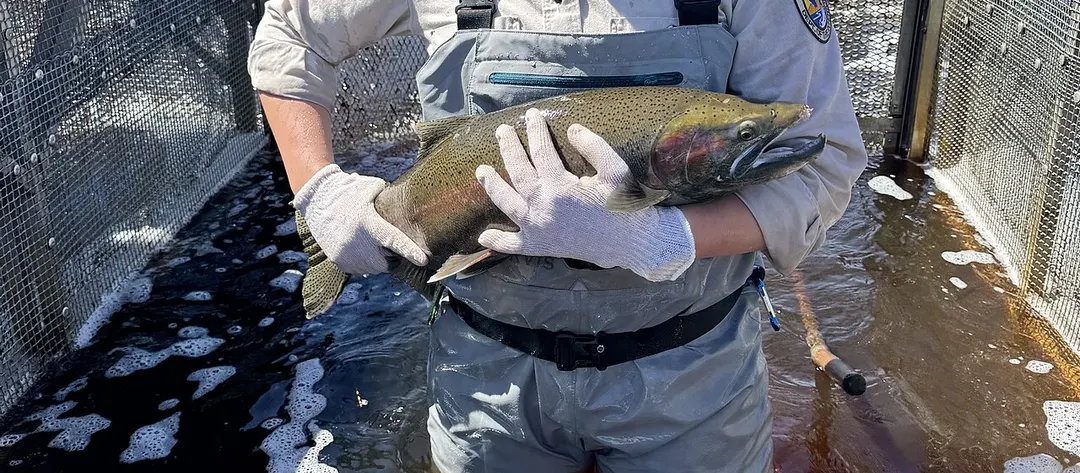
A biologist holds a steelhead trout captured in the sea lamprey trap in the Manistique River, Michigan.Photo: U.S. Fish and Wildlife Service, Midwest Region (cropped), public domain, via Wikimedia Commons. Taken in Michigan, not Ohio.
When do steelhead come into the rivers?
ODNR: Migrate into the tributaries from fall through spring.
(ODNR (PDF)) In the fall, anglers can find steelhead congregating along nearshore break walls, staging to run upriver.
(ODNR (PDF))
An ODNR biologist, in a Trout Unlimited chapter’s notes on his talk: Although a few enter rivers in October, most movement into the tributaries begins in November and continues all winter, particularly in times of high stream flow.
(Clear Fork River TU)
Cleveland Metroparks (April 6, 2023): The steelhead run tends to begin slowly tapering off through April most years, dropping off sharply as May approaches.
(Cleveland Metroparks report)
What gear do you need?
ODNR: During fall through spring, steelhead can be caught in the tributaries using spinning and fly tackle with spoons, spinners, egg imitators, and fly patterns.
(ODNR (PDF))
New York DEC, on its Lake Erie tributaries: Leave your ultralight spinning rod or 3-4 weight fly rod at home as these powerful fish can break lighter equipment.
(New York DEC) More often, steelhead anglers employ 8.5-10 foot rods with medium or medium-light action that are rated for 6-12 pound test line.
(New York DEC) A spinning combo works well for drifting egg sacs or casting spinners, spoons and stickbaits.
(New York DEC)
For fly anglers, New York DEC: However, a 7 weight, 10-foot-long rod is considered a good all-around steelhead rod for the Lake Erie tributaries.
(New York DEC) This size can be used effectively to dead drift egg patterns or swing streamer patterns.
(New York DEC) Most steelhead anglers go with a weight forward floating fly line because of its versatility; it can be used effectively for dead drifting with a strike indicator and also works well casting large streamers.
(New York DEC)
What bait works?
Lake Metroparks: A spawn sack drifting under a small bobber with a spinning outfit is very productive.
(lakemetroparks.com)
Cleveland Metroparks (April 6, 2023): In stained water it is tough to beat a hot pink or chartreuse nickel to quarter size spawn bag (trout and salmon eggs both work well).
(Cleveland Metroparks report) Additionally, as waters clear a variety of offerings will hook fish, including 1/32 and 1/64 oz marabou/hair/tube jigs tipped with a few waxworms or maggots, soft or hard salmon egg size beads, and live and salted emerald shiners- all drifted under a float.
(Cleveland Metroparks report)
Cleveland Metroparks (January 12, 2023): In the colder water, baits drifted under floats, such as marabou jig tipped with a minnow or a nightcrawlers, have the edge over casting hardware.
(Cleveland Metroparks report)
Pennsylvania Fish & Boat Commission: Pastebait - natural for clear water; bright colors for stained water
(PA Fish & Boat (PDF))
How do you fish a float or a drift?
New York DEC’s guide: Float (bobber) fishing is very effective for catching steelhead as it allows an angler to make long, snag-free drifts with the bait remaining in the strike zone.
(New York DEC (PDF)) You want to use enough weight to sink 3/4 of the float and to obtain a drift that presents the bait ahead of the float (J-shaped drift).
(New York DEC (PDF))
And for drift fishing: Drift fishing means presenting your bait just off the stream bottom.
(New York DEC (PDF))
Ohio Sea Grant: Keep all baits near the bottom, and expect to occasionally become snagged!
(Ohio Sea Grant article)
Pennsylvania Fish & Boat Commission’s steps: Cast the bait or fly upstream into holding water.
(PA Fish & Boat (PDF)) Set the hook if the bait or indicator hesitates.
(PA Fish & Boat (PDF))
How do you fly fish for them?
Lake Metroparks: A fly rod with any number of steelhead flies can also be great fun and highly effective.
(lakemetroparks.com)
From an Ohio guide’s talk, in a Trout Unlimited chapter’s notes: In high water with low clarity, larger fly patterns (size 4-6) are needed so fish can see them.
(Clear Fork River TU)
Where in the river do steelhead hold?
New York DEC’s guide says steelhead: Gather where two currents come together to form a “seam”
(New York DEC (PDF)); Hold above or below structure that buffers the current and provides security, such as large boulders or logs
(New York DEC (PDF)); Prefer the beginning and end of large pools
(New York DEC (PDF)).
Pennsylvania Fish & Boat Commission: Deep water, riffles, rocks or timber are ideal holding locations to fish.
(PA Fish & Boat (PDF))
Through the season, Ohio Sea Grant: During early to mid fall, concentrate efforts in stream pools closer to the lake.
(Ohio Sea Grant article) During late fall and winter, steelhead will have moved further upstream, providing more fishing opportunity.
(Ohio Sea Grant article) Come spring, steelhead can be found in deep pools, yet will also move to shallow, rock and gravel riffle areas for spawning.
(Ohio Sea Grant article)
How do flow, clarity and water temperature change things?
The ODNR biologist’s talk: Movement of steelhead from LE into the tributaries is triggered by increased flow rate in the streams and lower water temperatures.
(Clear Fork River TU)
Pennsylvania Fish & Boat Commission: The best opportunity to catch a steelhead is when the stream waters rise or fall.
(PA Fish & Boat (PDF))
New York DEC’s guide, in its list of what steelhead do: Move upstream on rising and falling water and hold steady in either low flows or flooding conditions
(New York DEC (PDF))
Cleveland Metroparks (April 6, 2023): The Rocky and Chagrin rivers are elevated and muddy from rain but will offer good steelhead fishing as the water begins to drop in level and clear.
(Cleveland Metroparks report)
From the Ohio guide’s talk: The best water clarity for successful steelheading is 18-24” of visibility. That is when you can barely see your boots in knee-deep water.
(Clear Fork River TU) At <8” of visibility, steelhead are very difficult to catch because they can’t see the flies.
(Clear Fork River TU) Steelhead are naturally cold-water fish and their prime temperature is 40F.
(Clear Fork River TU)
John Nagy, author of a steelhead guidebook: Late fall steelhead are still fairly active and aggressive but unusual cold snaps that drop tributary temperatures 4 or 5 degrees F or more can put a damper on an aggressive steelhead bite.
(John Nagy, steelhead guide author)
Our flow check: Are they biting? Today’s readings: river conditions.
How do you land and release a steelhead?
New York DEC’s guide: To release the fish, hold it upright facing into the current until it regains its strength and can swim away.
(New York DEC (PDF))
Pennsylvania Fish & Boat Commission: Allow the fish to revive in the water before releasing it.
(PA Fish & Boat (PDF))
The ODNR biologist’s talk: A very significant finding was that Ohio fishermen view steelhead primarily as a sport fishery, releasing about 90% of those they catch.
(Clear Fork River TU)
Limits and licensing: rules.
Anything else?
Ohio Sea Grant: Be careful of frozen areas; river and stream ice are never safe to walk upon.
(Ohio Sea Grant article)
In Ohio, you can only gain access to streams flowing on public property. If you are on private property, including land that streams flow over, you must have landowner permission.
(ODNR map (PDF))